
All opinions expressed in Paul's blogs are solely his own. They do not represent the opinions of his employers and/or associates.

Strange New Worlds
It is troubling to think that students don’t see their skills as transferable from one class to another, but how often do we give students reason to believe otherwise? Our education system long ago drew borders between the disciplines....Students cross a literal, physical threshold as they move between classes. That threshold tells them that when they enter their math class, it is now time for math, and it is no longer time for English. It makes sense, then, that they would dump their English literacy skills at the door.
Bridges Over Perceived Disciplinary Demarcations


This is an adaptation of my M.A. Defense. The video of the original defense presentation is provided at the end of this post.
When I was in seventh grade, I set out to write a science fiction novel. I was convinced that a good science fiction novel needed technology based on plausible science, so I began learning about physics in my free time. Among other results, writing this novel led me to try and understand Einsteinian physics when I was failing a class that asked, at most, for a basic understanding of Newtonian physics. I was grasping at science beyond my grade level (and comprehension), but it was all because of my love of the language arts.
I eventually scrapped that novel, but my love of science fiction still motivated me to learn in my free time. In high school, I continued being a mediocre student; I often worked on my own projects instead of my course work. Starting in 10th grade, I got particularly interested in an esoteric Japanese science fiction cartoon: an anime called Neon Genesis Evangelion. This series has dense (and nearly inaccessible) symbolism, which borrows from a variety of religious and psychological traditions. I ultimately wrote a 26,000 word paper unpacking all the layers of symbolism, and doing so sparked my passion for academic writing.
Wanting to write a novel began my love of learning for its own sake. Analyzing a science fiction anime gave me a passion for literary criticism and academic writing. My lasting goal of writing a science fiction novel persuaded me to enroll in college. Writing my sci-fi novel led me to learn about science and writing the analytical paper led me to learn about psychology and theology.
And yet, all of these connections and passions went all but unused in my undergraduate program. No one – not me, not my peers, and not my instructors – benefited from the exclusion and stagnation of my passions. Most of my undergraduate education in English had to happen in isolation from other disciplines and in isolation from my untraditional passions.
But I don’t really believe that my instructors felt their courses or content exists in isolation from other disciplines. And if you, dear reader, are a teacher, I don’t think you believe your content exists in isolation. In an unusual turn for my blogs, I would like to momentarily make this an interactive discussion. Through a brief activity, I think I can illustrate my point, and its problematic nature.
If you could take out a piece of paper, I’d like you to take just a couple minutes and build a web. In the center of the web, I’d like you to write down your main content area and/or specialization. From there, please take a couple minutes to construct a web of the other disciplines you feel your content area connects to.
It’s okay. I’ll wait.
I’ll bet you thought of quite a few connections. Now I have a follow-up question. You don’t need to draw this new web, but I’d like you to consider: if I asked your students to construct a web like this about your content area, what do you think it would look like? I bet theirs would be more limited, maybe much more limited. Do you agree?
This is not meant to criticize you or your methods. I suspect the problem runs much deeper than that. Research conducted by Linda Bergmann and Janet Zepernick at the University of Missouri of Science and Technology in 2007 suggested that students have great difficulty transferring their literacy and writing skills from one content area to another. In many cases, this seems to be due to an unwillingness to transfer those skills, or maybe more specifically, an inability to see them as transferrable. English courses were seen as particularly isolated, and students felt the writing skills they employed in English were arbitrary and irrelevant to other content areas.
It is troubling to think that students don’t see their skills as transferable from one class to another, but how often do we give students reason to believe otherwise? Our education system long ago drew borders between the disciplines. These borders tell us that science is something separate from English, that social studies are separate from psychology, and so on. By the time students reach college, they have generally dealt with these disciplinary demarcations for at least six years, if not closer to twelve. Students cross a literal, physical threshold as they move between classes. That threshold tells them that when they enter their math class, it is now time for math, and it is no longer time for English. It makes sense, then, that they would dump their English literacy skills at the door.
This even happens within a single content area. I never had the opportunity to take the science fiction course at CSU, but it was offered the same semester I took my advanced creative writing course. That class forbade us from writing science fiction or other “genre” fiction. That means that if I had taken the science fiction course, I would have been expected to leave the content from the science fiction class at the door when I crossed the threshold into my creative writing classroom. My ability to transfer what I learned would have been constrained even within the same department at the same university.
But as I predict your webs illustrate, that’s not how we, as teachers, think about our content areas. The borders between disciplines, like the borders between nations, are only as real as we, collectively, allow them to be. The borders only exist when we believe in and defend them. However, what makes this issue so insidious is that most people probably don’t realize they are defending the disciplinary separation and therefore are unintentionally fighting against transferability. The purpose of my project was to expand transferability and present the different disciplines as an interconnected and overlapping network, rather than divided continents.
In pursuing that goal, I decided to conduct research to explore how sound my reasoning was. The research questions that guided by study were:
- From the perspective of 107 students and 3 of their language arts teachers at a STEM middle school, what texts (books, movies, TV shows, and video games) qualify as science fiction? How do these students and teachers define science fiction? How might this shape their perception of science fiction?
- To what extent is there a positive correlation between students’ enjoyment of science fiction and their interests in STEM classes and careers?
- How popular is science fiction among students? Is science fiction often privileged in the language arts classroom? If not, why not?
- In what ways could science fiction serve as a hook for engaging students in interdisciplinary studies?
Looking at my data, students appear to have broad definitions of science fiction, and it’s usually synonymous with fantasy. More than half read science fiction “for fun,” but they report that teachers rarely or never assign science fiction in class. There is a particularly strong correlation between students’ interest in science and math, and their interests in science fiction movies. This suggests there may be an interdisciplinary connection between science fiction and STEM. These students may already be drawing interdisciplinary connections, as I did at their age. This was only am exploratory study, so it calls for further research. More importantly for this discussion, my project should not end with just revising my research tools, and it should not end with just science fiction.
From the beginning, I envisioned my project as part of a greater whole. When I first pitched it to my advisor, my project was going to involve building a course that employed both science fiction and fantasy to build much broader interdisciplinary connections. That turned out to be unrealistic in scope for both this project and any practical course design. However, that is an idea I would like to return to. All fiction offers valuable opportunities for connecting to other disciplines, and “genre” fiction can form some of the most valuable bridges. So I want my research and my course to be a beginning, not an end. I would like to design more courses in the future that involve using other genres for other kinds of interdisciplinary connections. Or, I would like to inspire others to do similar work.
I believe this kind of interdisciplinary work can better enable and support our students’ passions and better represent what we believe our disciplines to be. We can help transform your students’ hypothetical web into the web you drew. Working to make this shift will enrich both our students’ learning and our own teaching.
This won’t be a quick fix, and it will be particularly challenging in a hierarchical system dominated by state standards and mandates. But I don’t really think I’m asking teachers to embrace any new or alien ideas. Again, I do not think teachers truly believe their disciplines exist in isolation. My goal is to encourage them to take advantage of more avenues for helping students see their skills as transferable. I hope to remind teachers that they are not alone in their missions. And so, I can’t let this project end with me, nor can I let it be dominated by only my voice. While you, dear reader, and I do not represent every discipline, I hope that our conversation today can be one of many beginnings as our respective missions continue.
Note: This is an adapted version of my M.A. Defense, which is provided below.
A video of my defense. I apologize for the poor quality; my recording options were limited.
Out of this World
Science fiction is one of the best tools we have for empowering our students' identities and freeing their imaginations, while also encouraging critical thought with logical rationalization....There are plenty of obstacles in our way, but we have the power to ensure that we are not one of them. We can be allies in empowering students' imaginations in the sciences and the arts, whether they have down to earth dreams or ones that carry them out of this world.

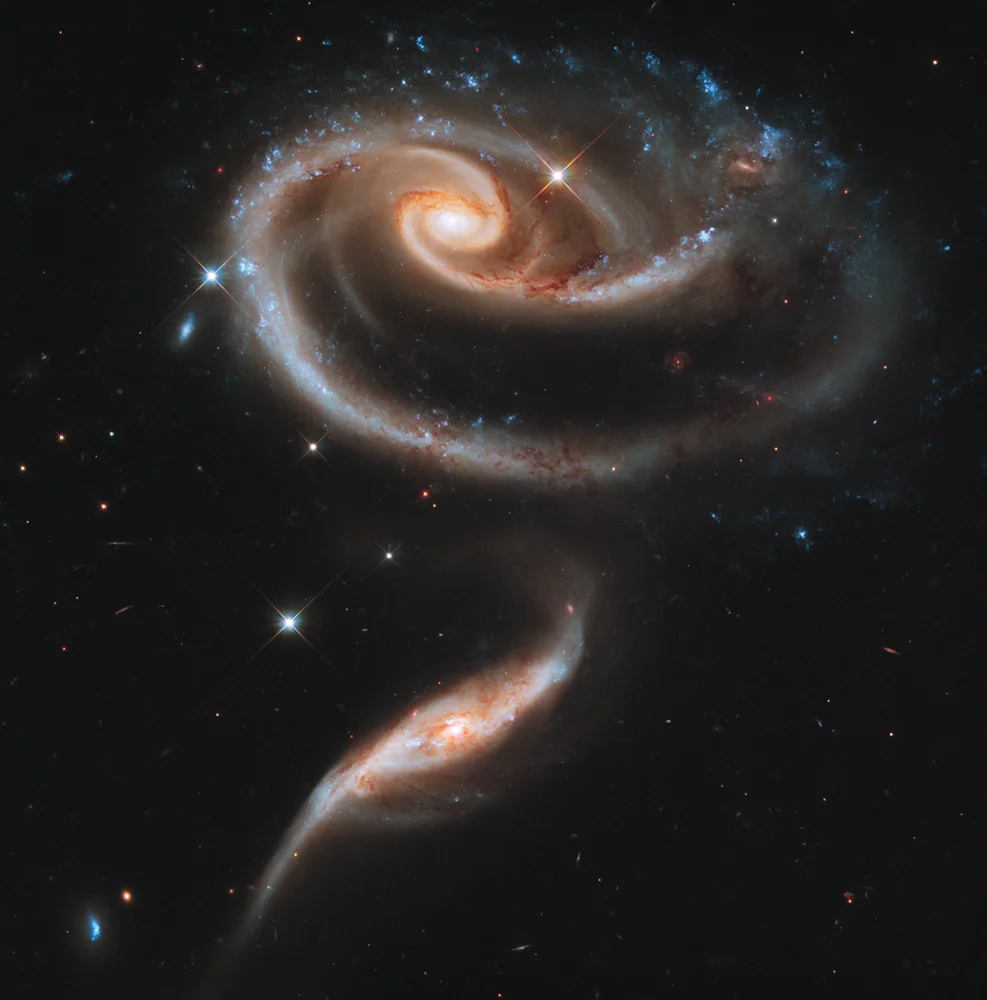
"A Rose Made of Galaxies Highlights Hubble's 21st Anniversary" Source: NASA
The Language Arts' Interdisciplinary Role in Fostering Imagination and Skepticism
Part 2 of 2
In my last blog post, I talked about how important the space program is to science education and our culture as a whole. Neil DeGrasse Tyson makes a good case that the space program benefits many parts of our society, but support for the space program has to come from a cultural shift, not just budgetary or legislative changes. Tyson primarily focuses on the space program’s relationship with the sciences. This reciprocal relationship is more obvious than, say, how the language arts can build support for the organizations like NASA, and benefit from its discoveries. One factor I previously argued hinders the space program is a lack of validation for students’ identities as scientists and having too few exciting opportunities for what they can do with their passion for the STEM fields once they’re out of school. I believe the two biggest contributions the language arts can make to NASA and the STEM fields is fostering students’ skepticism and imagination. The language arts are largely in the business of encouraging creativity, which depends upon imagination. Other aspects of the language arts, like literary criticism and critical reading, encourage students to think skeptically and critically.
I see two major roadblocks to skepticism and imagination being wholly embraced in the language arts classroom: treating the arts as an isolated field and marginalizing "genre" fiction in favor of "literary" fiction. The tendency to see English as something isolated from other fields, and particularly isolated from the STEM fields, suggests that skepticism in literature is something different from skepticism in the “hard” sciences. I do not believe many teachers truly believe the work of the English classroom is irrelevant to other fields, but our curriculum design, standardized tests, and public discourse about education often treat them as isolated concerns.
Imagination is actively supported in the English classroom when it comes to creative writing and even close reading skills, which often encourage students to picture what they read like a movie in their head. However, this pursuit is complicated by limits on what is permissible and privileged in the English classroom. “Literary" fiction is often the term for the relatively realistic fiction that is favored in many language arts classrooms and standards. This stands in contrast to “genre" fiction: a dirty word that encompasses many genres, which include science fiction, fantasy, and historical fiction. The rhetoric of these two labels makes a clear value judgment: one is literature and the other is not. The fostering of imagination is in no way absent from the language arts classroom, but too often it is limited.
The space program depends on students’ abilities to have grand dreams and great ambition. In an interview with The Atlantic, Neil DeGrasse Tyson illustrates how the sciences can suffer from dreams that are too down to earth:
If I say, ‘design me a plane that’s more fuel-efficient, because the country needs that now,’ you’re not going to get any truly transformative, innovative solutions. Instead, if I say, ‘Who wants to build an air foil that’ll navigate the rarified atmosphere of Mars?’ or ‘we’re about to go to Mars. Who wants to study life forms that are yet to be understood that we may discover?’ I’m going to get the best engineers; I’m going to get the best biologists. I’m going to get the best of those categories because it’s a goal befitting the depth of ambitions of those students.
NASA both depends upon and supports such a “depth of ambition.” The idea that students should restrain their imagining to realism risks devaluing students’ identities as readers, writers, and thinkers. It could also undermine the language arts’ potential for supporting the “culture of innovation” necessary for reinvigorating the space program.
Let us look at an example. Albert Einstein conducted a famous “thought experiment” at the age of sixteen. He imagined that he could travel as fast as a beam of light and wondered what it might look like; would it appear as a stationary wave or not? These musings launched him on the road of discovering his theory of special relativity. The theory itself outlines a universe that seems unintuitive: one where time is not constant. The theory of special relativity is arguably the most revolutionary scientific discovery of the twentieth century and it was born out of a teenager imagining he could travel as fast as a beam of light – which is, of course, absurd. That daydream is so far removed from the realm of the possible that it should have little bearing on reality, no “use value” in the Marxist sense. Why should someone imagine something that can never be achieved? Would time not be better spent daydreaming about a loved one, a future career, or practical inventions? Or perhaps it would be better to restrict scientific speculation to the here and now, based on personal experience and immediately observable reality? Proposing such limits would be unacceptable, and even antithetical, to a great deal of scientific thought. Yet these sorts of limits are encouraged by the philosophies that guide traditional literary culture and education.
Many students, myself included, first discovered a passion for reading through “genre” fiction. It took until third grade for me to willingly take up a book and read. More specifically, it took me discovering the Animorphs series, which revolve around teenagers who can transform into animals, thanks to alien-granted powers. They were absurd stories indeed. That passion for science fiction has never faded; my parents were able to convince my stubborn teenage self to enroll in college through the argument that I could study and write science fiction there. Throughout my undergraduate degree, I read the occasional science fiction text, and my intermediate creative writing class allowed us to write “genre” fiction. However, once I moved on to advanced creative writing, we were once again forbidden from writing anything beyond realism. There is an unfortunate irony in a creative writing or literature classroom forbidding students to write genres they’re passionate about. We are in the business of fostering creativity, and we are often prepared to fight against the demand that our arts have a “use value.” So why favor realism?
James Paul Gee’s book, Situated Language and Learning: A Critique of Traditional Schooling, focuses on how students acquire “specialist language” as a central part of education. To acquire this language, Gee argues that students must feel that they could have a valid identity, simulated or otherwise, as someone who uses that specialist language. In other words, a student would have to be able to feel they have a valid place as someone who “does” science before they could begin to willingly acquire the specialist words and knowledge of science. Gee adds that “people learn new ways with words, in or out of school, only when they find the worlds to which these words apply compelling.” I believe that some students closely associate their identities as readers and writers with science fiction and similar genres. Science fiction is often allowed during free time reading, but it is usually denied the prestige of proper literature. That is only a half-hearted nod to students’ identities, not true validation. If Gee is correct, excluding science fiction from serious academic discourse could run the risk of alienating students who feel that their identities as learners are being excluded as well. Frowning upon science fiction could then put us doubly at a disadvantage in our pursuit of a culture that has a passion for the sciences; we pass up the opportunity to use a uniquely applicable genre of fiction and we may distance some students from the knowledge and experiences we want them to gain in the English classroom.
The value of science fiction in the English classroom goes beyond building on students’ passions and identities; it is also has unique potential in the language arts. Critic Carl Freedman, in his book Critical Theory and Science Fiction, argues that science fiction is naturally inclined towards critical theory. He argues that “the science fiction world is not only one different in time or place from our own, but one whose chief interest is precisely [that] difference.” In contrasting a fictional world against our own, science fiction becomes a dialectical act of criticism. Science fiction author and critic Samuel R. Delany echoes Freedman’s emphasis on difference in his article “The Semiology of Silence.” Delany argues that the world building that is central to most science fiction is an argument about the world we inhabit. He points to the common theme of faster-than-light travel as being an argument that the Einsteinian model of the universe will be changed in the future, if not wholly overthrown. Delany celebrates this potential in science fiction because these arguments about our present world are “[portrayed] clearly, forcefully, and with tremendous verbal economy,” the very traits that are valued in literature and creative writing classes.
Delany hones his argument down to the possible meaning science fiction can construct even at the sentence level. He provides the examples “her world exploded” and “he turned on his left side.” In realism, the possible meanings of these sentences are very limited. In “genre” fiction, new possibilities for meaning are opened up; a world really could explode in science fiction, or perhaps a man is turning on is robotic left side. Those examples might be a little fanciful, but is that any reason to discourage students from finding genuine enjoyment by playing with the possibilities of language? In the language arts, don’t we have every reason to encourage such playfulness with language? Critical, dialectical, and creative thought are all at the heart of the language arts. Science fiction is a unique way to approach all three, from large-scale world building to small-scale sentence construction.
Science fiction’s role in the language arts and the sciences come together in another defining feature of the genre: speculation and rationalization. Speculation is rooted in the known. The inventions, technologies, species, and events in science fiction tend to be built out of some part of the author’s past or present. But another defining feature of science fiction is that these speculative elements are rationalized within the story; stories tend to give some explanation for how they came to be or how they work, at varying degrees of plausibility. This is the core of scientific thought; this is the literary form of hypothesizing and experimenting. Returning to the example of Einstein imagining himself as traveling as fast as a beam of light, this speculation would not have become truly valuable without Einstein’s attempts to rationalize this situation (or, more specifically, his inability to rationalize it). Likewise, his speculation would not be as revolutionary if it wasn't so absurd.
The same dance of speculation and rationalization is necessary in the language arts. Rationalization can happen in literature in ordinary ways; characters and events must be constructed in believable ways or readers likely won’t find them relatable. Rationalization in realistic fiction alone may lead to some understanding about human behavior which is undeniably valuable, but it is less likely to lead to something new, or a novum in the favored word of many science fiction theorists. In literary criticism, speculation that cannot be rationalized will not be very persuasive. Conversely, an argument that is not very original, not built out of enough speculation and creative thought, will not be very interesting. Like science, the arts lose much of their significance without powerful imagination and logical rationalization in the pursuit of something new. That is where science fiction builds a unifying bridge between the disciplines.
As much as I am passionate about the sciences, and as much as I want new avenues to “hook” students into the STEM fields, I do not mean to privilege them above the language arts. STEM is becoming a widespread fad in education, surely due in part to its apparent economic use value. The end goal of the arts should not be to support the sciences. Nor should the end goal of the sciences be to support the arts. Instead I mean to emphasize that these fields are not as disparate as they may often seem. Teachers in both fields are not alone in their missions. There are many ways to bridge the apparent gap between these disciplines, but I firmly believe one of the most effective connections can be built through science fiction and other genres that allow students’ imaginations to be unfettered by reality.
For the language arts to support the culture of innovation Tyson emphasizes, I propose that we follow the argument of Carl Sagan in the opening segment of the original Cosmos:
We wish to pursue the truth no matter where it leads. But to find the truth we need imagination and skepticism both. We will not be afraid to speculate, but we will be careful to distinguish speculation from fact. The cosmos is full beyond measure of elegant truths, exquisite interrelationships, of the awesome machinery of nature.
The surface of the earth is the shore of the comic ocean. On this shore, we’ve learned most of what we know. Recently we’ve waded a little way out, maybe ankle deep, and the water seems inviting. Some part of our being knows this is where we came from. We long to return, and we can, because the cosmos is also within us; we’re made of star stuff. We are a way for the cosmos to know itself. The journey for each of us begins [in our imaginations]…it will carry us to worlds of dreams and worlds of facts. Come with me.
Sagan himself is a creative, eloquent, and skeptically rational man. Without the artistry of his language, Sagan would have been less effective in persuading and moving his audience. Without his dedication to skepticism and logic, he would not have helped make such significant strides in astrophysics and astronomy. Science fiction is one of our best tools for empowering our students’ identities and freeing their imaginations, while also encouraging critical thought and logical rationalization. Accepting this idea requires only a small shift: instead of beginning with content students must learn and finding ways to incorporate their passions where we can, we instead begin with their passions and find ways to incorporate the necessary curriculum into that framework. There are plenty of obstacles in our way, but we have the power to ensure that we are not one of them. We can be allies in empowering students’ imaginations in the sciences and the arts, whether they have down to earth dreams or ones that carry them out of this world.
Works Consulted
Delany, Samuel R., Sinda Grefory, and Larry McCaffery. “Semiology of Silence.” Science Fiction Studies 14.2 (1987): 134-164. JSTOR. Web. 24 April 2014.
Freedman, Carl. Critical Theory and Science Fiction. Hanover, NH: Wesleyan University Press, 2000. Print.
Gee, James Paul. Situated Language and Learning: A Critique of Traditional Schooling. New York: Routledge, 2004. Print.
“The Shores of the Cosmic Ocean.” Cosmos. Writ. Carl Sagan, Ann Druyan, and Steven Soter. Dir. Adrian Malone. Carl Sagan Productions, 1980. DVD.