
All opinions expressed in Paul's blogs are solely his own. They do not represent the opinions of his employers and/or associates.

A Defense of Public Schools
I strongly believe we should focus our investment, financially and otherwise, on supporting and reforming traditional public schools when needed. DeVos, if confirmed, threatens the survival of traditional public schools, but she is far from the only threat. A national obsession with charter schools, while not always misguided, is a more immediate and long-lived challenge. Both issues must be confronted in the defense of public schools.
Countering Charters, Vouchers, and Betsy DeVos
Note: At times I will refer to “public schools” in contrast to “charter schools.” This is solely for clarity and ease in this conversation. It is important to note that charter schools are public schools; they just operate differently than traditional public schools.

Betsy DaVos confirmation hearing (Source: CSPAN)
This past week, there was a congressional confirmation hearing for the new president’s Secretary of Education nominee, Betsy DeVos (provided in its entirety below). DeVos is a staunch – and influential – advocate for school voucher programs. Voucher programs involve providing public tax dollars to parents for attending a wide variety of schools, often including private and religious schools. DeVos has also been a strong supporter of charter schools. Those two efforts combined, and particularly voucher programs, would gut traditional public schools, though (very crucially) not abolish them completely. There will be students who will never have any other choice than their neighborhood schools; the ability to attend private or charter schools often depends on very simple privileges, such as parents who can drive their kids to school every day. Leaving underprivileged kids at schools that are bled all but dry of their funding does a disservice to us all. Our society and our democracy are best served by a well-educated populace. Moreover, our children benefit from being around people who are unlike them, in privilege, identity, heritage, and ability. I strongly believe we should focus our investment, financially and otherwise, on supporting traditional public schools and reforming them as needed. DeVos, if confirmed, threatens the survival of traditional public schools, but she is far from the only threat. A national obsession with charter schools, while not always misguided, is a more immediate and long-lived challenge. Both issues must be confronted in the defense of public schools.
Recently over lunch, I was talking to one of my colleagues about a local charter school. She had some favorable things to say about that charter school. Among them was that the students at that school “actually want to be there.” I can imagine that she was right, and there is definitely something appealing about that as a teacher. I’ve had plenty of students who didn’t want to be in my class, or in school at all, and that is difficult to work with. But that conflict is one of the most important parts of the mission of public education. We will all pay a price, sometimes literally, for not giving every child a quality education. DeVos and others would argue that charter schools or voucher programs are the best path to quality. I argue that the more scattered our school population becomes, and the more power becomes concentrated in exclusionary schools, the further we move away from a model that will work for every child. That isn’t to say problems don’t exist in our current public schools and public school system. Many problems exist, and various kinds of reform will be needed to ensure their quality and survival.
Enter: outsiders with ideas on how to ensure quality education for everyone. There are a many proposed solutions, with varying price tags attached (sometimes more literally than others). Outsiders are often favored for varying reasons, including the belief that reform needs to come from outside of the system. When looking to reform public schools, the outsiders of choice usually come from the business world. And so we have Betsy DeVos, with control of the Department of Education nearly in hand. DeVos’ status as an outsider is nothing shocking in education administration: we are a field governed by non-experts. Nor is it shocking that DeVos has no teaching experience, no formal training related to the field, and did not send her kids to public schools. Particularly when picked by Donald Trump, that seems to be par for the course.
Unsurprising as it may be, DeVos’ lack of knowledge on the subject is troubling, and may have very serious consequences if she is confirmed. Her lack of qualification is not my main focus in this post, but it speaks to the issue of having non-experts (from the business world or otherwise) govern education. Two particular points on which she seems to lack knowledge are relevant to what follows: her confusion in regards to the Individuals with Disabilities Education Act (IDEA) and on the difference between “growth” and “proficiency” in assessment.
IDEA is a federal law passed during Nixon’s time in office that requires schools receiving federal money to offer equal access to students with disabilities (physical, cognitive, or emotional). DeVos’ answer was that this sort of requirement should be decided at the state level, showing a lack of awareness that it is an existing federal law which her department would be in charge of enforcing. Although the law isn’t new, constant effort is needed to ensure its requirement are met – all the more so if private schools are going to start receiving public federal money.
In assessment, “growth” measures the progress a student makes in a particular area, where “proficiency” measures them against a specific benchmark. To illustrate the difference, assessing whether a student can read at a 9th grade level is assessing his proficiency. Looking at a students’ reading level at the end of the year relative to where she started (say, beginning 9th grade with a 4th grade level and ending at a 7th grade reading level) is assessing her growth. At a glance, “growth” versus “proficiency” may seem like a semantic debate over two jargon words for the same concept – and in fact, that seems to be what DeVos thought it was – but in practice, they are significantly different. That distinction is crucial when it comes to using standardized assessment to determine federal school funding.
These two points are salient, because they show a lack of understanding about two factors that are explicitly related to her (potential) future Department, and because they illustrate the kind of issues that can arise when someone with only a general familiarity with a field is assigned to run it. DeVos is problematically unqualified, and her nomination is another play in a long-running effort to reform schools from the outside, often with business-people, or at least business-management ideals, leading the charge. In these discussions, teachers are often not treated as competent, let alone trustworthy, professionals. They are instead viewed as the key problem in education: a colony of potentially beneficial bacteria that, if not managed by an outside authority, will rot the host. This treatment isn’t alien to all other fields, but few or none are distrusted to the degree that teachers are. When proof is needed for why teachers aren’t trustworthy, a number of bad teachers can be trotted out. Even in your own life, you can probably think of a couple truly terrible teachers. I certainly can. Instead, individuals or companies from the business world are brought in to set teachers straight and reform the profession. I can’t imagine this would be tolerated in any other field, but in education it has been accepted enough that business leaders are given increasingly larger slices of our system.
I’m an English teacher, so I am drawn to metaphors. Perhaps what follows won’t qualify as a good one, but I hope you’ll indulge me. Imagine that you are a civil engineer, and you are an expert in building bridges for busy roads. In a year, hundreds of people drive over these bridges, with a wide range of vehicles. You need to build a bridge that can support all of those vehicles and all of that wear. If you fail and someone gets hurt, it won’t just affect that one person: it will affect the many people she knows and those who depend on her.

A less-than stable bridge (Source)
Now, building bridges like this is important work, and we all have a stake in whether the bridge collapses or not. So, I, an English teacher, come in to make sure the construction is done right. I have never built a bridge, and I have no education in this field. However, a team of bridge builders is kind of like a classroom: they both involve managing people and working towards a specific goal. What’s more, I’ve driven over a lot of bridges in my time. I tell you, the engineer, how best to build this bridge. If you don’t listen to me, you may lose your job. If your workers’ union tries to oppose me, I’ll talk to my friends and see if we can diminish the power of that union.
People wouldn’t tolerate what I’ve described above. It’s silly, and there could be serious, far-reaching, and expensive consequences if I got it wrong. It could work, but I wouldn’t bet on it. However, this is (an exaggerated version of) what teachers deal with. We are already a field run by non-experts. And there are some out there who think the non-experts have too little influence. Or, in the words or Senator Joseph Lieberman introducing DeVos, that being a non-expert is “the most important qualifications you could have” for education administration.
While DeVos represents this problem, she is far from the only billionaire exerting control over the field. The Common Core State Standards (CCSS), like any system of standardization, has both good and bad aspects, but it is also hard to ignore the role corporations had in their creation. The research that argued the CCSS were needed was funded in no small part by Microsoft and Walmart. Then those same organizations funded the development of the CCSS. That, in itself, isn’t a bad thing, but it speaks to the power corporations have over our education system, when they can argue that their system is necessary, design that system, and see it adopted in the majority of states – including setting high stakes for teacher effectiveness as measured by these standards. In other words, those corporations get to tell us there's a problem, create its solution, and ensure that teachers are held accountable to their created solution.
The importance of K-12 teaching experience is precisely why teacher education programs require student teaching. Our university education offers invaluable insight, theories, and practica, but many of those are challenged by, or even broken by, the day-to-day demands, issues, and limitations of public school education. This disconnect is even greater when it comes to people with no experience in the field (other than, perhaps, attending or observing a public school). Managerial maxims may sound useful, but they rarely account for the issues public schools face. As mentioned in my previous post, those issues can be best summed up by saying public schools must consume every imaginable social issue in hopes developing a cure. Few CEOs have to worry about whether the people in their building were homeless last night, or if their parents recently tried to murder them, or if they have an unidentified need that makes their work far more difficult than it is for any of their peers. Those are all issues I have encountered in less than a year.
I do not mean to frame this as an either-or issue, or to cast businesses as villains. There are a lot of good things businesses have to offer the education world, ranging from new ideas to financial support. A partnership between public schools and businesses can be incredibly valuable. But a partnership is very different from one administrating the other. In my more cynical moments, I feel that businesses mean the business-education partnership to be primarily one-way: directing schools and teachers how to better serve businesses’ interests. Far less common is the idea that schools and teachers should inform the practices of the business or political world. Yet schools still reap the consequences of business and political decisions and are left to pick up the pieces.
In Why School?: Reclaiming Education for All of Us, UCLA professor Mike Rose argues that:
“A further, larger, issue is this: in all the public discussions I’ve heard, the focus of school-business alliances is solely on the problems with the schools and what businesses can do to remedy those problems. The discussion never seems to include businesses’ contributions to the conditions that have limited educational achievement” (77).
As for those “conditions that have limited achievement,” Rose is more specific on the following page, describing “an ongoing, damaging trend in American business that pushes short-term interests over long-term prosperity and the social good” (78). A look at the new president and his cabinet validate Rose’s words.
Charter schools are, indeed, public schools, but they have more freedom in how they operate and are often founded and/or run by people from the business world. In some cases, they are even run as for-profit entities or by for-profit management companies. That is distinctly different from traditional public schools, and, according to Mike Rose, “there is a danger of the profit motive trumping educational goals” (76). The greater freedom charter schools are given can cut both ways. In short, charter schools lessen regulations and give those schools greater freedom. Depending on who is at the helm of those schools, that could be valuable and produce excellent results. However, if this greater freedom and authority is handed over to unqualified or misguided authorities, it can be ineffective or even harmful.
But even the schools that produce excellent results can deny access to, or expel and suspend, a far greater number of students than public schools can. So, while charter schools are public schools in some regards, there are meaningful differences when it comes to educating our entire population. As highlighted in an article from The Atlantic, some charter schools (including, perhaps tellingly, ones with high test scores and general performance) suspend, expel, and refuse entry to students with disabilities and students of color at a higher rate than their public school peers. The authors of that article “express concern that some charter schools are dissuading children with disabilities from enrolling, which may contribute to the high marks some zero-tolerance schools report.” Moreover, increased school of choice results in greater segregation in race and socio-economic status. Having a choice of schools depends upon also have certain degrees of privilege.
Traditional public schools have an obligation to provide access and education to all of the students within their boundaries. That creates many challenges, class size not the least among them. As with charter schools where the kids “actually want to be there,” I can understand the appeal of refusing entry or not educating everyone, but that is a terrible, selfish vice that I must be aware of and fight against. Education isn’t about making my life easier, and our schools shouldn’t be shaped by such a selfish desire. As an early career teacher, I certainly have my share of struggles in maintaining a safe, equitable, and rigorous environment in my classroom. It is, frankly, very difficult to educate every student and confront their wide variety of challenges. However, that work being so difficult, and the challenges being so numerous and diverse, is precisely why we need to do it. If educating the most difficult students feels like a Herculean – or even Sisyphean – task for knowledgeable, highly trained professionals, then those students would likely have little chance of receiving a quality education elsewhere.
I can’t imagine anyone truly thinking that our public school system needs no reform. There are many issues, both with individual schools and the system as a whole. However, we are not faced with the false choice of leaving the system as it is or effectively abandoning it in favor of charter schools, private schools, and vouchers. There are reasonable compromises between this false dichotomy. Like school-business partnerships, there are undeniably good things that private schools and charter schools have to offer, but that does not erase their flaws. I would much rather see their ideas be used to inform public school reform rather than draining public schools’ funding and diminishing the traditional public school model as a whole. Thinking that public schools can be reformed by giving their funding to private schools, and more to charter schools than we already do, is like thinking that you can rebuild a house by walking off with most of its pieces.

Thomas Jefferson
I am a firm believer in the mission of public education, but as with charter schools, its virtues do not negate the current system’s flaws. If we mean to keep public education – and we should; there is no reasonable alternative – then it is in our best interest to reform our system, borrowing the methods that work while still striving to ensure universal access. Universal education, at least in accordance with Founding Fathers’ perspective on “universal” at the time, is an ideal that stretches back to the beginnings of education in the United States. To quote Thomas Jefferson, “If a nation expects to be ignorant & free, in a state of civilisation, it expects what never was & never will be….Where the press is free and every man able to read, all is safe.” Or, as it is often paraphrased, “An educated citizenry is a vital requisite for our survival as a free people.”
We have stumbled in this pursuit, and failures have caused measurable harm, but the answer is to fight for reforms, not to abandon ship into a sea of charter and private schools. The single biggest challenge, and the single greatest value, of public education is the need to try to save everyone. The fight is daunting, and there are many improvements needed, but there is no worthier cause. The fight will always be a long-term one, but the short term is made more precarious as individuals like DeVos stand on the brink of controlling the machinery of our public education system. It falls to us, as teachers and as citizens, to defend it.
Works Consulted
Bill and Melinda Gates Foundation. “Smart Options: Investing the Recovery Funds for Student Success.” Gatesfoundation.org, 9 April 2009, https://docs.gatesfoundation.org/Documents/investing-the-recovery-funds-for-student-success.pdf. Accessed 21 Jan 2017
Brown, Emma. “Trump Picks Billionaire Betsy DeVos, School Voucher Advocate, as Education Secretary.” Washington Post, 23 Nov 2016, https://www.washingtonpost.com/local/education/trump-picks-billionaire-betsy-devos-school-voucher-advocate-as-education-secretary/2016/11/23/c3d66b94-af96-11e6-840f-e3ebab6bcdd3_story.html?utm_term=.f241d4484aee. Accessed 21 Jan 2017
Deruy, Emily. “Unequal Discipline at Charter Schools.” The Atlantic, 18 Mar 2016, https://www.theatlantic.com/education/archive/2016/03/unequal-discipline-at-charter-schools/474459/. Accessed 21 Jan 2017
Glatter, Hayley. “Can School Choice Work in Rural Areas?” The Atlantic, 19 Jan 2017, https://www.theatlantic.com/education/archive/2017/01/can-school-choice-work-in-rural-areas/513584/. Accessed 21 Jan 2017
National Conference of State Legislators. “School Vouchers.” ncsl.org, 20 June 2013, http://www.ncsl.org/research/education/school-choice-vouchers.aspx. Accessed 21 Jan 2017
Nelson, Libby. “Betsy DeVos was Asked a Basic Question about Education – and Couldn’t Answer.” Vox.com, 17 Jan 2017, http://www.vox.com/2017/1/17/14304692/devos-confirmation-hearing-education. Accessed 21 Jan 2017
Rose, Mike. Why School?: Reclaiming Education for All of Us. The New Press, 2014.
Strauss, Valerie. “Betsy DeVos Apparently ‘Confused’ about Federal Law Protecting Students with Disabilities.” Washington Post, 17 Jan 2017, https://www.washingtonpost.com/news/answer-sheet/wp/2017/01/17/betsy-devos-confused-about-federal-law-protecting-students-with-disabilities/?utm_term=.12b237a390f5. Accessed 21 Jan 2017
Sum, Andrew, Ishwar Khatiwada, Joseph McLaughlin, and Sheila Palma. “The Consequences of Dropping Out of High School: Joblessness and Jailing for High School Dropouts and the High Cost for Taxpayers.” Center for Labor Market Studies. Boston, Massachusetts: Northeastern University, Oct 2009, https://www.prisonpolicy.org/scans/The_Consequences_of_Dropping_Out_of_High_School.pdf
Swasey, Christel. “David Coleman: Dropping All Things Beautiful from American Schools.” Common Core: Education Without Representation, 17 Dec 2012, https://whatiscommoncore.wordpress.com/2012/12/17/4484/. Accessed 21 Jan 2017

Waking Up in Donald Trump's America
Trump’s election shifts more responsibility onto each of us to build the sort of social discourse that will likely be challenged in the years to come....We must hold ourselves and others to a higher standard in our social discourse. We must strive to have even greater empathy, including for those we resent. We have a more exigent obligation to promote and enact social justice....Our future as a sane and functional society may well depend on our ability to enact decency in the face of dissolution.
Anxiety about the Future of Education and Social Discourse

Source: Slate.com
It is under unfortunate circumstances that I break my long radio silence, but writing is an invaluable tool for making sense of trying times.
While we, as educators, have an obligation to not be partisan in our classrooms, it is no secret that, as a private citizen, I have a strong dislike for – even fear of – Donald Trump. My wife is a woman of color. My mother-in-law is a Mexican immigrant and a legal resident, but not a citizen. I have friends and students who are members of the LGBTQ community. I know people whose lives have been significantly improved by having access to abortion services. It’s hard for me to not feel that all of those things are in danger now. Additionally, our social discourse will almost certainly be reshaped during Trump’s presidential term. The die is cast; there’s no going back now. So the question is: how do we move forward from here?
Before I move on, I need to own my privilege. I am a cisgendered, heterosexual, able-bodied, middle-class, white male. I fall into a group that is among those who have the least to fear from Trump. While I feel it is important to acknowledge that my rights are less endangered than the rights of many other people, thinking that that means I don’t have any “skin in the game” is precisely the sort of thinking that has led us to a Donald Trump presidency. Moreover, as someone who is effectively an employee of the federal government, my professional identity cannot be separated from the results of this election. Far, far up the chain of command, Donald Trump will be my boss.
This is a very serious topic, and we are on the brink of very serious consequences, but I hope I can be forgiven for turning to Star Trek in this time of need. In the past, I have said (only half-joking) that when I was growing up, I learned morality by watching Star Trek: The Next Generation. In one episodes, “The Drumhead,” Captain Jean-Luc Picard is among those put on trial during a witch hunt. While he is on the stand, he quotes a fictional judge who said:
“‘With the first link, the chain is forged. The first speech censored, the first thought forbidden, the first freedom denied, chains us all irrevocably.’ Those words were uttered by Judge Aaron Satie, as wisdom and warning. The first time any man’s freedom is trodden on, we’re all damaged.”
I feel there is good reason to be apprehensive, or even afraid, as we look at the years to come. With Trump’s party controlling both chambers of Congress, and with his opportunity to nominate at least one Supreme Court Justice, it would be naïve to think progressive causes won’t be undermined. However, we cannot let this blind us to the need for empathy or trap us in apathy and despair. And I do not mean only empathy for those who may become even more disenfranchised and oppressed. We also have an obligation to be empathetic to those who brought Trump into power. When Trump’s election is being called the “biggest upset in American history,” there is clearly something about the people in this country that we did not understand, or at least underestimated. We do not have the luxury of ignoring them now.
The election results revealed a stark divide between rural and urban voters, not to mention a stark divide in gender and race. It is easy to feel resentment after these results, and to react with hostility or smugness towards Trump’s wave of rural, white men who don’t hold a college degree. But that is not the way forward. In fact, that approach likely has something to do with how we got here. Having empathy towards people with which we profoundly disagree, and towards people who threaten our liberties, is hard, but it is also necessary. We cannot dismiss their grievances, and we cannot deny their political power.
The need for empathy is particularly important for educators, and we are also uniquely positioned to promote social change. I teach in a state that has such an extreme rural/urban divide that eleven of our counties even put forward a ballot initiative to break away from Colorado and become the 51st state. That ostensibly serious effort was motivated specifically by feeling that rural counties were neglected by a state that gave disproportionate attention to our more urban counties. Hillary Clinton ultimately won Colorado, but Trump overwhelmingly won in our rural counties. Many of my students come from families that likely feel they have been left behind in the changing landscape of American and ignored in narratives and economics that privilege cities over towns. I don’t get to pick and choose which students I care about or support. I have an obligation to all of them.
Yet, Trump’s rhetoric and behavior have been validated, and that will surely have a ripple effects. We are likely to see his actions and words replicated (in one way or another) in our classrooms. Virtually every minority group has reason to feel threatened, regardless of what the reality turns out to be. There is a very realistic possibility people of color, women, and members of the LGBTQ community will see their rights curtained. That means we have a heightened obligation to set and hold firm to standards of what is acceptable classroom behavior. The already tenuous and inconsistent nature of classrooms as “safe spaces” will be challenged. At this time, I am troubled by a quote my grad advisor shared from one of her past colleagues: “Is it my job to change the world or just make them more articulate bigots?” It is hard for me to not feel that bigotry has just won.
We can’t let ourselves fall into the trap of apathy or resentment. If I may trot out a clichéd quote from Gandhi, we must instead “be the change [we] wish to see in the world.” As our national social discourse becomes less civil, we must fight to maintain civility in our classrooms. As the notion that we don’t need to respect the needs of others grows, we must build a classroom culture defined by respect. Through careful and challenging work, we can strive to let a these standards spread outwards from our classrooms: into our communities, and beyond, even if our schools become strapped for resources. Perhaps that is overly idealistic, but in difficult times, I will gladly take idealism over fear.
Trump’s election shifts more responsibility onto each of us to build the sort of social discourse that will likely be challenged in the years to come. No blog post of mine would be complete without a Carl Sagan quote, so while Sagan was talking about the fragile nature of the Earth, I believe Trump’s election “underscores our responsibility to deal more kindly with one another.” We must hold ourselves and others to a higher standard in our social discourse. We must strive to have even greater empathy, including for those we resent. We have a more exigent obligation to promote and enact social justice.
However, we must find a way to do so without being smug and without shaming others. We must find a way to pursue these goals that does not alienate the people who have empowered this demagogue. Trump is anything but a unifier, so the onus falls to us to find means of unifying our bruised and fractured society. That goal begins in both our homes and our schools. Our future as a sane and functional society may well depend on our ability to enact decency in the face of dissolution.
For each day I wake up in Trump's America, I will try to remember the words of comedian Justin McElroy from last night:
I'm gonna wake up and keep trying to do good and so are you and nobody gets to vote on that.
— Justin McElroy (@JustinMcElroy) November 9, 2016
Let's keep trying.
Works Consulted
Associated Press. “Gender Gap Proves Crucial: Working-class Men Strengthen Trump’s Bid.” Times Union, 9 Nov. 2016. http://www.timesunion.com/news/article/Gender-gap-proves-crucial-10603292.php Accessed 9 Nov. 2016.
Bouie, Jamelle. “How Trump Happened: It’s Not Just Anger Over Jobs and Immigration. White Voters Hope Trump Will Restore the Racial Hierarchy Upended by Barack Obama.” Slate.com, 13 March 2016. http://www.slate.com/articles/news_and_politics/cover_story/2016/03/how_donald_trump_happened_racism_against_barack_obama.html Accessed 9 Nov. 2016.
"The Drumhead." Star Trek: The Next Generation, written by Jeri Taylor, directed by Jonathan Frakes, CBS, 1991.
Goldberg, Michael. “Discourse.” Washington.edu. https://faculty.washington.edu/mlg/courses/definitions/discourse.html Accessed 9 Nov. 2016.
Goldmacher, Shane and Ben Schreckinger. “Trump Pulls Off Biggest Upset in U.S. History: Markets are Already Reeling After the Billionaire Scores Stunning Win Over Clinton.” Politico.com, 9 Nov. 2016. http://www.politico.com/story/2016/11/election-results-2016-clinton-trump-231070 Accessed 9 Nov. 2016.
Johnson, Pamela. “Thompson Tax Issues Fail: Supporter Shocked, Wonder What Now.” Reporter Herald, 8 Nov. 2016. http://www.reporterherald.com/news/ci_30552262/thompson-tax-issues-fail Accessed 9 Nov. 2016
Pickett, RaeAnn. “Trigger Warnings and Safe Spaces Are Necessary.” Time.com, 31 August 2016. http://time.com/4471806/trigger-warnings-safe-spaces/ Accessed 9 Nov. 2016.
Rensin, Emmett. “The Smug Style in American Liberalism.” Vox.com, 21 April 2016. http://www.vox.com/2016/4/21/11451378/smug-american-liberalism Accessed 9 Nov. 2016.
Sagan, Carl. The Pale Blue Dot: A Vision of the Human Future in Space. New York: Random House, 1994.
Whaley, Monte. “51st State Question Answered ‘No’ in 6 of 11 Counties Contemplating Secession.” The Denver Post, 5 Nov. 2015. http://www.denverpost.com/2013/11/05/51st-state-question-answered-no-in-6-of-11-counties-contemplating-secession/ Accessed 9 Nov. 2016.
Wong, David. “How Half of America Lost its F**king Mind.” Cracked.com, 12 Oct. 2016. http://www.cracked.com/blog/6-reasons-trumps-rise-that-no-one-talks-about/ Accessed 9 Nov. 2016.
Zitner, Aaron and Paul Overberg. “Rural Vote Fuels Trump; Clinton Loses Urban Grip: Division Persists in the Electorate that Have Been in Place for Years.” The Wall Street Journal, 9 Nov. 2016. http://www.wsj.com/articles/rural-vote-helps-donald-trump-as-hillary-clinton-holds-cities-1478664251 Accessed 9 Nov. 2016.
Activism of Convenience
Language and icons are powerful, and flag are among the most pervasive and powerful symbols. We need to confront these symbols, particularly when they are embraced as part of such a high-profile act of violence. However, we cannot let this discussion end there; we cannot practice only activism of convenience. The popularity of the Confederate flag is a symptom of a larger system and we must treat it as such.
The Confederate Flag, White Privilege, and Social Justice

Source: CNN.com
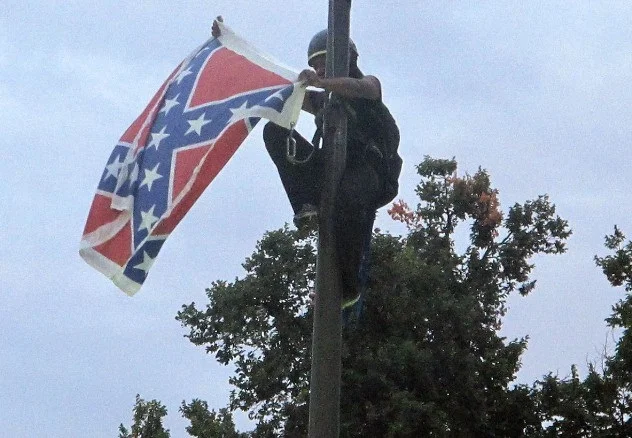
The Confederate battle flag has become increasingly unpopular after the racially motivated shooting in Charleston, South Carolina, which left nine members of the Emanuel African Methodist Episcopal Church dead. The Confederate flag was hardly the only racist symbol the killer embraced, but the flag has become the primary target of public outrage since the attack. As an English major and composition instructor, I am very familiar with the power language and symbols wield. Their power is real and often insidious. Identifying the Confederate battle flag as a symbol of hate and racism is important, and I am appreciative that we are having this conversation, but I believe that in many cases the backlash against the flag has been activism of convenience.
The Confederate flag is certainly cherished by many people, but they constitute a subculture. The majority of Americans and dominant American society have no substantial attachment to the flag, so removing the flag from statehouses or store shelves requires little sacrifice. It is among the least controversial steps a public figure or company could take to combat racism. Again, it is not a meaningless gesture, and some have certainly gone to greater lengths than others to enact change. But this activism of convenience is illustrated well in a quote from Annin Flagmakers: America’s oldest existing manufacturer of flags. As paraphrased in an article on NJ.com, “The Confederate flag represents only a small portion of the company's business.” Some financial and PR risks are likely involved in making such a decision, but most American companies and citizens have very little stake in the future of the Confederate flag.
When we take on social justice issues on the basis of convenience and focus our energies on the lowest stake issues, we can still enact change, but it is less powerful than taking on root causes. There has been no shortage of finger-pointing and social-media activism playing out on online:

A Facebook exchange with the governor of South Carolina (Source)
While posts like this one touch on more uncomfortable truths than taking down flags, laying blame along ideological lines offers another escape from responsibility. I am not speaking in favor of white guilt, self-loathing, or censorship, but I do feel we need to have an honest, critical dialogue that does not end at a flag. I believe there is a productive middle ground between white guilt and avoiding responsibility for systemic oppression in our country, and the overemphasis on the Confederate flag risks distracting us from more meaningful and uncomfortable work.
White supremacy was constructed by white people. It was designed and perpetuated for their benefit. As such, it should be the responsibility of white people to confront it. Even those of us who have never remotely supported any white supremacist organization have at least a responsibility to speak against overtly racist sentiments, particularly when we encounter them directly. However, if you’re like me, you’re unlikely to run into or consort with the blatant, old-fashioned white supremacy perpetuated by people like Dylan Roof, but you may regularly benefit from white privilege, which helps keep systemic oppression both alive and silent.
Dr. Robin DiAngelo uses the term “white fragility” to describe the discomfort and resistance many feel when discussing white privilege (you can find her full article here). Discussing white privilege, particularly when it comes from a person of color, can feel like an attack. After all, I did have to do a lot of hard work to be where I am today, but that doesn’t mean I didn’t have help and advantageous conditions in which to do that work. But this is exactly why our country’s dominant discourse and media should not let this discussion end with how we should react to the Confederate flag. Those in positions of power and privilege – whether politicians, prominent media figures, or those who enjoy more small-scale privilege – are particularly qualified to contribute to meaningful discussion on systemic racism. As a white male, I can make my discussion of these issues less of an attack when I am willing to acknowledge my privilege without discrediting the work I’ve also needed to do throughout my life. As a white male, I get to talk about white privilege in terms of “we”: I’m in this uncomfortable position with you; I know it can feel demeaning to acknowledge our own privilege. But I also know we can be self-critical and take responsibility for the system that supports us without throwing ourselves into a spiral of self-loathing.
Language and icons are powerful, and flags are among the most pervasive and powerful symbols. We need to confront these symbols, particularly when they are embraced as part of such a high-profile act of violence. However, we cannot let this discussion end there; we cannot practice only activism of convenience. The popularity of the Confederate flag is a symptom of a larger system and we must treat it as such. It is our duty to critically examine forces like revisionist history (in its many forms) and the double standard that treats acts committed by white criminals as lone-wolf anomalies while treating criminals of color (or even victims) and indicative of problems that define an entire group of people. These critical discussions will be controversial and uncomfortable, but if we mean to enact change and justice, these inconvenient actions are necessary.
Works Consulted
DiAngelo, Robin. “White Fragility.” International Journal of Critical Pedagogy 3.3 (2011): 54-70. University of North Carolina Greensboro. Web. 4 July 2015.
---. “Why It’s so Hard to Talk to White People About Racism.” Huffington Post, 30 April 2015. Web. 4 July 2015.
Feinberg, Ashley. “White Men Wave Their Butts in the Air for the Confederacy.” Gawker, 30 June 2015. Web. 4 July 2015.
Haley, Nikki. “Facebook post.” Facebook, 17 June 2015. Web. 4 July 2015.
Holley, Peter and DeNeel L. Brown. “Woman Takes Down Confederate Flag in Front of South Carolina Statehouse.” Washington Post, 27 June 2015. Web. 4 July 2015.
Loewen, James W. "Why Do People Believe Myths about the Confederacy? Because Our Textbooks and Monuments are Wrong." Washington Post, 1 July 2015. Web. 4 July 2015.
Marzanec, Pam. "Facebook comment." Facebook, 27 Sept 2014. Web. 4 July 2015.
O’Brien, Kathleen. “N.J. Flagmaker Halts Production of the Confederate Flag.” NJ.com, 23 June 2015. Web. 4 July 2015.
Schmidt, Michael S. “Charleston Suspect Was in Contact with Supremacists, Officials Say.” New York Times, 3 July 2015. Web. 4 July 2015.
Tumulty, Karen and Lyndsey Layton. “Changes in AP History Trigger a Culture Class in Colorado.” Washington Post, 5 October 2014. Web. 4 July 2015.
Wing, Nick. “When the Media Treats White Suspects and Killers Better than Black Victims.” Huffington Post, 14 August 2014. Web. 4 July 2015.
Ageism and Erasure in Colorado Curriculum Conflicts
The chairman may disapprove of students being civilly disobedient, but it seems he thinks students would only do so at the command of some outside influence. That attitude demeans students' autonomy by suggesting that they could never have the idea or drive to speak out on matters that affect them. Instead, they must be puppets for some group of adults set on corrupting our youths. "Ageism" is a clunky word, but it seems to fit here; these students' protests are being diminished by the chairman (among others) seemingly based on their age. Give them a few years and Witt may be able to more comfortably write them off as misguided adults, responsible for their own ignorance. Until then, he has to resign himself to writing them off as incapable of having an interest in education and social justice in their own right.

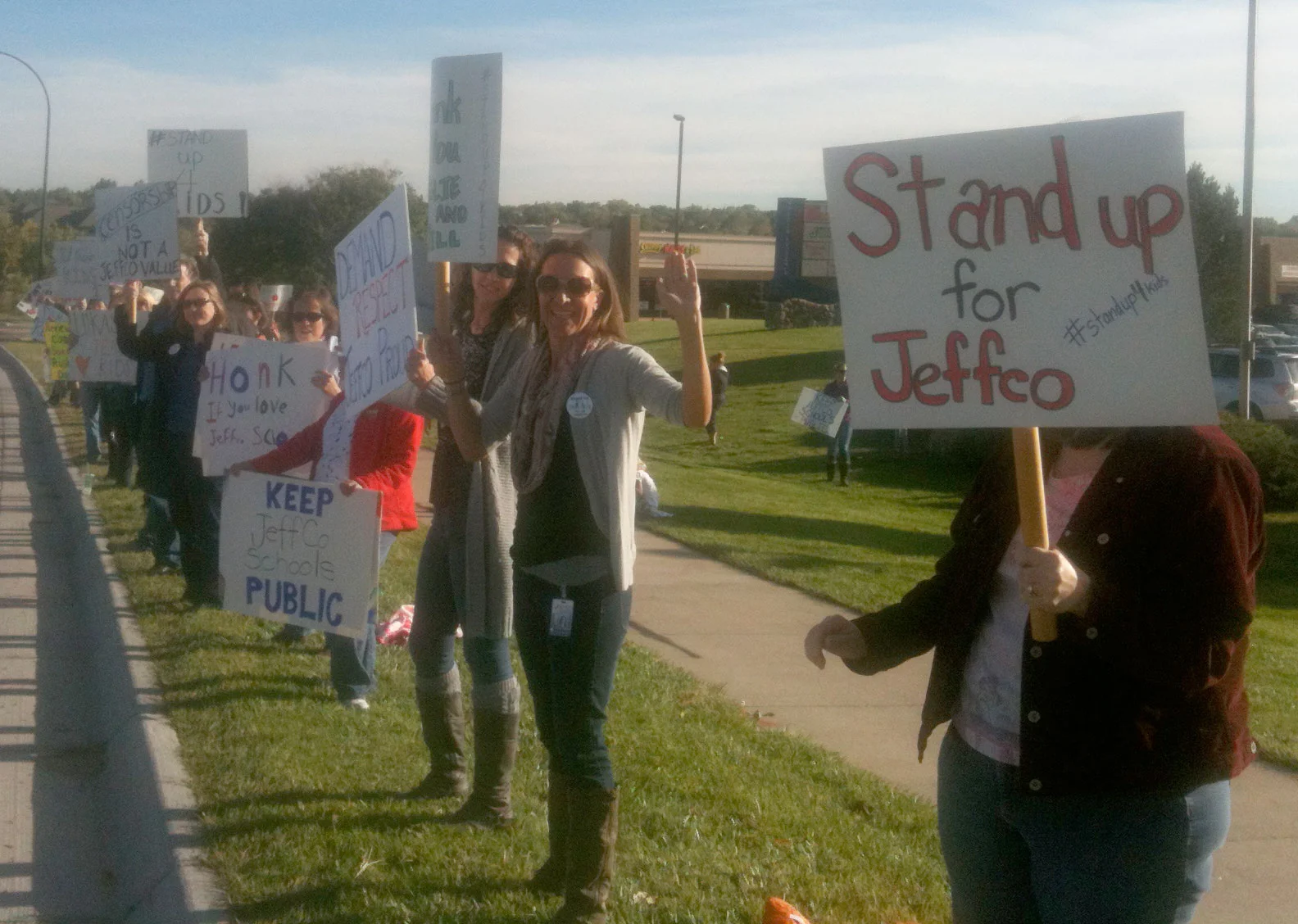
Jefferson Country, not far down the road from Colorado State University, has been experiencing public controversy following the school board's proposal to have a curriculum oversight committee with the ability to make changes to what schools teach. This specifically involves the history curriculum, following new AP history standards. This proposal resulted in public outcry and debate, in Jefferson County and across the country. Backlash against it included a mass "sick out" by teachers which resulted in two high schools closing for the day and protests by students. These student protests were condemned by board chairman Ken Witt:
"It's a shame we see kids on the streets instead of the classrooms...It is never OK to use kids as pawns, and it's what I think is happening here...the union message coming down through the teacher to get kids to deliberately get out and protest something they don't have any facts about whatsoever."
This criticism is made all the more poignant when a central point of contention in the board's proposed curriculum changes is to avoid texts which might encourage "civil disobedience, social strife or disregard for the law" and instead emphasize patriotism and the "positive aspects" of U.S. history.
The chairman may disapprove of students being civilly disobedient, but it seems he thinks students would only do so at the command of some outside influence. That attitude demeans students' autonomy by suggesting that they could never have the idea or drive to speak out on matters that affect them. Instead, they must be puppets for some group of adults set on corrupting our youths. "Ageism" is a clunky word, but it seems to fit here; these students' protests are being diminished by the chairman (among others) seemingly based on their age. Give them a few years and Witt may be able to more comfortably write them off as misguided adults, responsible for their own ignorance. Until then, he has to resign himself to writing them off as incapable of having an interest in education and social justice in their own right.
Beyond Resistance: Youth Activism and Community Change, by Shawn Ginwright, Pedro Noguera, and Julio Cammarota express views very much at odds with the attitude of Witt and those like him. The case studies within Beyond Resistance emphasizes the important role social activism can have in education, particularly for children of color and other marginalized groups. The first chapter of this book charts changes in education in California and the resultant changes in attitudes towards youth, particularly youths of color. In that chapter, Daniel Hosang describes the "antagonistic stance toward youth raised outside the sanctity of white middle- and upper-class life" that rose out of the 1980's. This led to "profiling the growing number of black and brown Californians as both menacing and undeserving." Various approaches have been taken to address the "problem" with these youths, such as emphasizing after-school programs.
In the sixth chapter of Beyond Resistance, by Ben Krishner, he remarks "youth must also have the opportunity to speak up and transform institutions shaping their lives." This chapter focuses on how adults can foster youth activists through apprenticeship systems in which the adult surrenders enough power to properly empower the youth. In other words, this design (as with YPAR) is to avoid the "puppet master" role of adults in the way Ben Witt fears. Instead, it puts faith in youth in believing they can (and want to) make a difference in their communities and the power structures that govern their lives.
Jefferson County is not California in many ways, not the least of which is its racial demographic. The population of Jefferson County is 79.9% white. Although Colorado's struggles may not be identical to California's, this distrust and disempowerment is made all the more troubling in light of the push against materials that might not put white Americans in sufficiently positive light. There is a version of white privilege that has cropped up its head in our education policy: one that opposes teaching about America's mistakes and darker eras. In a county where people of color are a significant minority, such a Eurocentric message may be all the more successful in solidifying white privilege and framing any resistance to that privilege as oppression.
Jefferson County's politics is not an isolated issue in Colorado. Pam Mazanec, a member of the Colorado Board of Education, also criticized the AP changes. In a series of comments on Facebook, Mazanec expresses her concern that the AP standards were designed primarily to promote an "agenda," rather than accurate information (her only cited source is the conservative National Association of Scholars). As an example, she points to white people not being given enough credit for "voluntarily" ending slavery:
"Yes, we practiced slavery. But we also ended it voluntarily, at great sacrifice, while the practice continues in many countries still today!...This is part of the argument that America is exceptional." She also adds, "the concern is that what students need to learn to do well is a negative view of much of our history."
I will say there are plenty of things to celebrate about the United States, but a thorough and accurate understanding of American history should include all Americans, and it often hasn't been a happy story for everyone. People of color and women are just as significant of a part of our history as a bunch of old white men, and America's history with those marginalized groups has quite a few negative things worthy of serious discussion. No one is saying students shouldn't learn about some of the positive, remarkable, and exceptional things that have happened in American history, but we cannot pretend to have an accurate picture of our past or present without recognizing and learning from our mistakes.
Colorado is more fertile of ground for these white-privilege-laden ideologies than I would like to admit as a native-born Coloradoan. In that context, it is all the more encouraging to see students protesting these changes. This sort of youth civil disobedience and activism is exactly what we need in our education system, which is almost exclusively run by adults. At risk of being "ageist" myself, I think there is a problematic disconnect between the ideologies of some members of older generations and the subtlety oppressive reality many youths face. If we mean to erase or downplay the complicated and, yes, often negative history that helped construct these oppressive structures, these marginalized groups will have that much less of a reason to feel they really can be heard or have valid opinions on the issues that affect them.
Above all, we should fight the claim that civil disobedience is somehow separated from patriotism or a functional society. If I had to select the early trait of America I consider to be most exceptional it would be the foresight to include in Article V of the Constitution the ability to add amendments. Any truly just society must be one that understands mistakes will be made and change is necessary. To grow as a society, we will benefit from meaningful discussions of our failings and even from civil disobedience, when necessary. Age should be no reason to discourage civic involvement, and we should not degrade youth activism by assuming they could only be interested in their society against their will. And if they're not interested on their own, we should seriously consider what we may have done to make them think they should not or cannot have an invested interest.
Works Consulted
"2012 Demographic Update." Jefferco.us. Jefferson County, 2012. Web. 15 Oct 2014.
Ginwright, Shawn, Pedro Noguera, and Julio Cammarota. Beyond Resistance: Youth Activism and Community Change. New York: Routledge, 2006. Print.
Gorksi, Eric. "Jeffco school board curriculum committee idea latest divisive issue." Denver Post.com. The Denver Post, 25 Sept 2014. Web. 14 Oct 2014.
Gorski, Eric and Kiernan Nicholson. "Two Jeffco high schools close Friday after teachers absent." Denver Post.com. The Denver Post, 19 Sept 2014. Web. 14 Oct 2014.
Mazanec, Pam. "Facebook comment." Facebook. 27 Sept 2014. Web. 15 Oct 2014.