
All opinions expressed in Paul's blogs are solely his own. They do not represent the opinions of his employers and/or associates.
Out of this World
Science fiction is one of the best tools we have for empowering our students' identities and freeing their imaginations, while also encouraging critical thought with logical rationalization....There are plenty of obstacles in our way, but we have the power to ensure that we are not one of them. We can be allies in empowering students' imaginations in the sciences and the arts, whether they have down to earth dreams or ones that carry them out of this world.

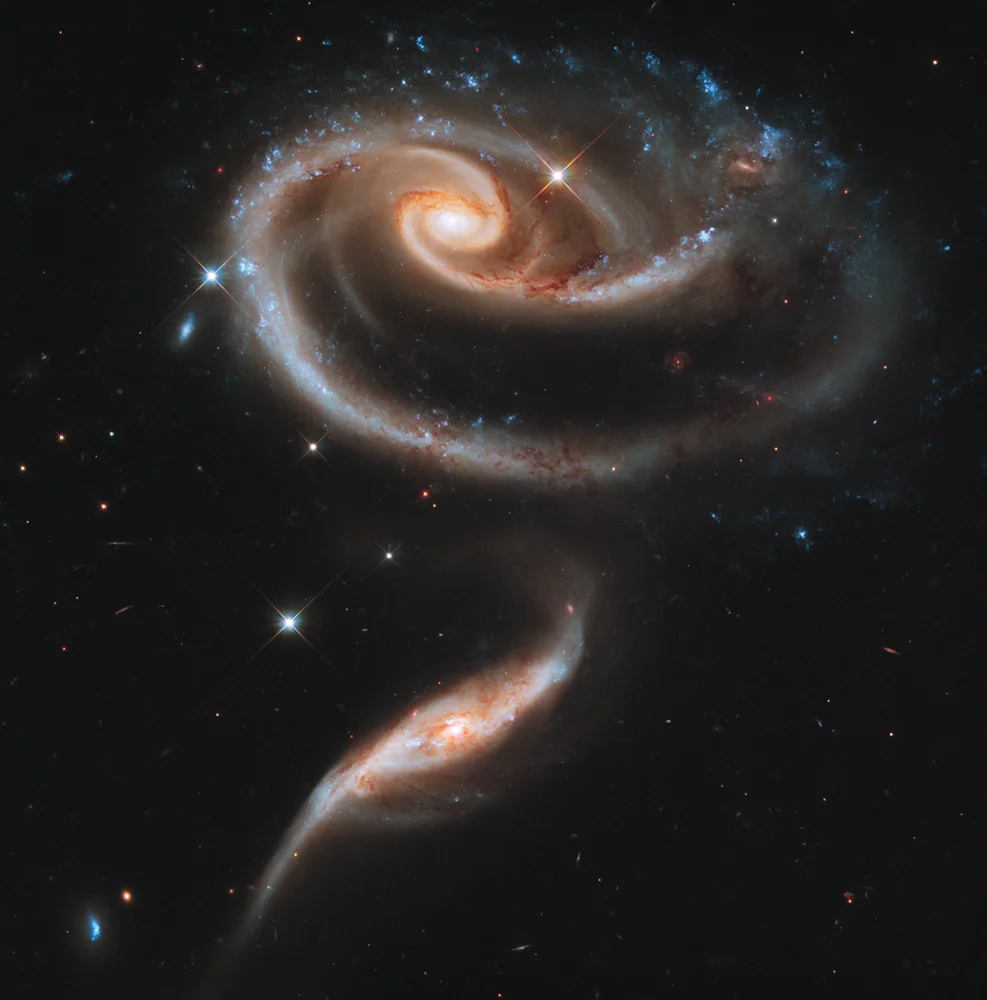
"A Rose Made of Galaxies Highlights Hubble's 21st Anniversary" Source: NASA
The Language Arts' Interdisciplinary Role in Fostering Imagination and Skepticism
Part 2 of 2
In my last blog post, I talked about how important the space program is to science education and our culture as a whole. Neil DeGrasse Tyson makes a good case that the space program benefits many parts of our society, but support for the space program has to come from a cultural shift, not just budgetary or legislative changes. Tyson primarily focuses on the space program’s relationship with the sciences. This reciprocal relationship is more obvious than, say, how the language arts can build support for the organizations like NASA, and benefit from its discoveries. One factor I previously argued hinders the space program is a lack of validation for students’ identities as scientists and having too few exciting opportunities for what they can do with their passion for the STEM fields once they’re out of school. I believe the two biggest contributions the language arts can make to NASA and the STEM fields is fostering students’ skepticism and imagination. The language arts are largely in the business of encouraging creativity, which depends upon imagination. Other aspects of the language arts, like literary criticism and critical reading, encourage students to think skeptically and critically.
I see two major roadblocks to skepticism and imagination being wholly embraced in the language arts classroom: treating the arts as an isolated field and marginalizing "genre" fiction in favor of "literary" fiction. The tendency to see English as something isolated from other fields, and particularly isolated from the STEM fields, suggests that skepticism in literature is something different from skepticism in the “hard” sciences. I do not believe many teachers truly believe the work of the English classroom is irrelevant to other fields, but our curriculum design, standardized tests, and public discourse about education often treat them as isolated concerns.
Imagination is actively supported in the English classroom when it comes to creative writing and even close reading skills, which often encourage students to picture what they read like a movie in their head. However, this pursuit is complicated by limits on what is permissible and privileged in the English classroom. “Literary" fiction is often the term for the relatively realistic fiction that is favored in many language arts classrooms and standards. This stands in contrast to “genre" fiction: a dirty word that encompasses many genres, which include science fiction, fantasy, and historical fiction. The rhetoric of these two labels makes a clear value judgment: one is literature and the other is not. The fostering of imagination is in no way absent from the language arts classroom, but too often it is limited.
The space program depends on students’ abilities to have grand dreams and great ambition. In an interview with The Atlantic, Neil DeGrasse Tyson illustrates how the sciences can suffer from dreams that are too down to earth:
If I say, ‘design me a plane that’s more fuel-efficient, because the country needs that now,’ you’re not going to get any truly transformative, innovative solutions. Instead, if I say, ‘Who wants to build an air foil that’ll navigate the rarified atmosphere of Mars?’ or ‘we’re about to go to Mars. Who wants to study life forms that are yet to be understood that we may discover?’ I’m going to get the best engineers; I’m going to get the best biologists. I’m going to get the best of those categories because it’s a goal befitting the depth of ambitions of those students.
NASA both depends upon and supports such a “depth of ambition.” The idea that students should restrain their imagining to realism risks devaluing students’ identities as readers, writers, and thinkers. It could also undermine the language arts’ potential for supporting the “culture of innovation” necessary for reinvigorating the space program.
Let us look at an example. Albert Einstein conducted a famous “thought experiment” at the age of sixteen. He imagined that he could travel as fast as a beam of light and wondered what it might look like; would it appear as a stationary wave or not? These musings launched him on the road of discovering his theory of special relativity. The theory itself outlines a universe that seems unintuitive: one where time is not constant. The theory of special relativity is arguably the most revolutionary scientific discovery of the twentieth century and it was born out of a teenager imagining he could travel as fast as a beam of light – which is, of course, absurd. That daydream is so far removed from the realm of the possible that it should have little bearing on reality, no “use value” in the Marxist sense. Why should someone imagine something that can never be achieved? Would time not be better spent daydreaming about a loved one, a future career, or practical inventions? Or perhaps it would be better to restrict scientific speculation to the here and now, based on personal experience and immediately observable reality? Proposing such limits would be unacceptable, and even antithetical, to a great deal of scientific thought. Yet these sorts of limits are encouraged by the philosophies that guide traditional literary culture and education.
Many students, myself included, first discovered a passion for reading through “genre” fiction. It took until third grade for me to willingly take up a book and read. More specifically, it took me discovering the Animorphs series, which revolve around teenagers who can transform into animals, thanks to alien-granted powers. They were absurd stories indeed. That passion for science fiction has never faded; my parents were able to convince my stubborn teenage self to enroll in college through the argument that I could study and write science fiction there. Throughout my undergraduate degree, I read the occasional science fiction text, and my intermediate creative writing class allowed us to write “genre” fiction. However, once I moved on to advanced creative writing, we were once again forbidden from writing anything beyond realism. There is an unfortunate irony in a creative writing or literature classroom forbidding students to write genres they’re passionate about. We are in the business of fostering creativity, and we are often prepared to fight against the demand that our arts have a “use value.” So why favor realism?
James Paul Gee’s book, Situated Language and Learning: A Critique of Traditional Schooling, focuses on how students acquire “specialist language” as a central part of education. To acquire this language, Gee argues that students must feel that they could have a valid identity, simulated or otherwise, as someone who uses that specialist language. In other words, a student would have to be able to feel they have a valid place as someone who “does” science before they could begin to willingly acquire the specialist words and knowledge of science. Gee adds that “people learn new ways with words, in or out of school, only when they find the worlds to which these words apply compelling.” I believe that some students closely associate their identities as readers and writers with science fiction and similar genres. Science fiction is often allowed during free time reading, but it is usually denied the prestige of proper literature. That is only a half-hearted nod to students’ identities, not true validation. If Gee is correct, excluding science fiction from serious academic discourse could run the risk of alienating students who feel that their identities as learners are being excluded as well. Frowning upon science fiction could then put us doubly at a disadvantage in our pursuit of a culture that has a passion for the sciences; we pass up the opportunity to use a uniquely applicable genre of fiction and we may distance some students from the knowledge and experiences we want them to gain in the English classroom.
The value of science fiction in the English classroom goes beyond building on students’ passions and identities; it is also has unique potential in the language arts. Critic Carl Freedman, in his book Critical Theory and Science Fiction, argues that science fiction is naturally inclined towards critical theory. He argues that “the science fiction world is not only one different in time or place from our own, but one whose chief interest is precisely [that] difference.” In contrasting a fictional world against our own, science fiction becomes a dialectical act of criticism. Science fiction author and critic Samuel R. Delany echoes Freedman’s emphasis on difference in his article “The Semiology of Silence.” Delany argues that the world building that is central to most science fiction is an argument about the world we inhabit. He points to the common theme of faster-than-light travel as being an argument that the Einsteinian model of the universe will be changed in the future, if not wholly overthrown. Delany celebrates this potential in science fiction because these arguments about our present world are “[portrayed] clearly, forcefully, and with tremendous verbal economy,” the very traits that are valued in literature and creative writing classes.
Delany hones his argument down to the possible meaning science fiction can construct even at the sentence level. He provides the examples “her world exploded” and “he turned on his left side.” In realism, the possible meanings of these sentences are very limited. In “genre” fiction, new possibilities for meaning are opened up; a world really could explode in science fiction, or perhaps a man is turning on is robotic left side. Those examples might be a little fanciful, but is that any reason to discourage students from finding genuine enjoyment by playing with the possibilities of language? In the language arts, don’t we have every reason to encourage such playfulness with language? Critical, dialectical, and creative thought are all at the heart of the language arts. Science fiction is a unique way to approach all three, from large-scale world building to small-scale sentence construction.
Science fiction’s role in the language arts and the sciences come together in another defining feature of the genre: speculation and rationalization. Speculation is rooted in the known. The inventions, technologies, species, and events in science fiction tend to be built out of some part of the author’s past or present. But another defining feature of science fiction is that these speculative elements are rationalized within the story; stories tend to give some explanation for how they came to be or how they work, at varying degrees of plausibility. This is the core of scientific thought; this is the literary form of hypothesizing and experimenting. Returning to the example of Einstein imagining himself as traveling as fast as a beam of light, this speculation would not have become truly valuable without Einstein’s attempts to rationalize this situation (or, more specifically, his inability to rationalize it). Likewise, his speculation would not be as revolutionary if it wasn't so absurd.
The same dance of speculation and rationalization is necessary in the language arts. Rationalization can happen in literature in ordinary ways; characters and events must be constructed in believable ways or readers likely won’t find them relatable. Rationalization in realistic fiction alone may lead to some understanding about human behavior which is undeniably valuable, but it is less likely to lead to something new, or a novum in the favored word of many science fiction theorists. In literary criticism, speculation that cannot be rationalized will not be very persuasive. Conversely, an argument that is not very original, not built out of enough speculation and creative thought, will not be very interesting. Like science, the arts lose much of their significance without powerful imagination and logical rationalization in the pursuit of something new. That is where science fiction builds a unifying bridge between the disciplines.
As much as I am passionate about the sciences, and as much as I want new avenues to “hook” students into the STEM fields, I do not mean to privilege them above the language arts. STEM is becoming a widespread fad in education, surely due in part to its apparent economic use value. The end goal of the arts should not be to support the sciences. Nor should the end goal of the sciences be to support the arts. Instead I mean to emphasize that these fields are not as disparate as they may often seem. Teachers in both fields are not alone in their missions. There are many ways to bridge the apparent gap between these disciplines, but I firmly believe one of the most effective connections can be built through science fiction and other genres that allow students’ imaginations to be unfettered by reality.
For the language arts to support the culture of innovation Tyson emphasizes, I propose that we follow the argument of Carl Sagan in the opening segment of the original Cosmos:
We wish to pursue the truth no matter where it leads. But to find the truth we need imagination and skepticism both. We will not be afraid to speculate, but we will be careful to distinguish speculation from fact. The cosmos is full beyond measure of elegant truths, exquisite interrelationships, of the awesome machinery of nature.
The surface of the earth is the shore of the comic ocean. On this shore, we’ve learned most of what we know. Recently we’ve waded a little way out, maybe ankle deep, and the water seems inviting. Some part of our being knows this is where we came from. We long to return, and we can, because the cosmos is also within us; we’re made of star stuff. We are a way for the cosmos to know itself. The journey for each of us begins [in our imaginations]…it will carry us to worlds of dreams and worlds of facts. Come with me.
Sagan himself is a creative, eloquent, and skeptically rational man. Without the artistry of his language, Sagan would have been less effective in persuading and moving his audience. Without his dedication to skepticism and logic, he would not have helped make such significant strides in astrophysics and astronomy. Science fiction is one of our best tools for empowering our students’ identities and freeing their imaginations, while also encouraging critical thought and logical rationalization. Accepting this idea requires only a small shift: instead of beginning with content students must learn and finding ways to incorporate their passions where we can, we instead begin with their passions and find ways to incorporate the necessary curriculum into that framework. There are plenty of obstacles in our way, but we have the power to ensure that we are not one of them. We can be allies in empowering students’ imaginations in the sciences and the arts, whether they have down to earth dreams or ones that carry them out of this world.
Works Consulted
Delany, Samuel R., Sinda Grefory, and Larry McCaffery. “Semiology of Silence.” Science Fiction Studies 14.2 (1987): 134-164. JSTOR. Web. 24 April 2014.
Freedman, Carl. Critical Theory and Science Fiction. Hanover, NH: Wesleyan University Press, 2000. Print.
Gee, James Paul. Situated Language and Learning: A Critique of Traditional Schooling. New York: Routledge, 2004. Print.
“The Shores of the Cosmic Ocean.” Cosmos. Writ. Carl Sagan, Ann Druyan, and Steven Soter. Dir. Adrian Malone. Carl Sagan Productions, 1980. DVD.

Down to Earth
Children often dream of growing up to be superheroes, and astronauts still qualified as superheroes when I was young. Now, NASA’s budget is a shadow of what it once was, the United States has to hitch a ride with other countries in order to get people into space, and there are few exciting prospects for human space travel in the near future. Appreciation for space exploration and its impact on our culture have faded as I’ve grown up. The superheroes have fallen back to earth.

Astronaut Karen Nyberg in the International Space Station. (Source: NASA)
The Decline of the Space Program
Part 1 of 2
Starting when I was five, my brother and I would sometimes sneak out of bed at 5:00 or 6:00 a.m. to watch TV. Our usual TV fare consisted of cartoons and Star Trek: The Next Generation, but these early morning escapades were for something different. On those occasions, we would turn to the public access channel to watch something we found truly amazing: a Space Shuttle launch. These events could drag on for more than an hour with little activity and almost no sound or voice-over. There must have been something truly magical about such an event if what was effectively a still image could hold the attention of a five- and seven-year-old for so long. I grew up watching Star Trek, Star Wars, and most other science fiction I could get my hands on. The launch of a Space Shuttle was a chance to see real-world space heroes in action.
When I was a child, the space program was still making the headlines. Two years before I was born, the Space Shuttle Challenger exploded shortly after takeoff. The first component of the International Space Station was launched when I was ten. Mir, which I had the good fortune of once seeing through a telescope, was decommissioned and destroyed when I was thirteen. When I was fifteen, the Space Shuttle Columbia broke up on re-entry. Finally, when I was 23, NASA launched the Space Shuttle for the last time.
The people who risked their lives in these voyages, and the engineers who made it possible, were rightly considered heroes. It was no surprise, then, that kids my age wanted to grow up to be astronauts. Children often dream of growing up to be superheroes, and astronauts still qualified as superheroes when I was young. Now, NASA’s budget is a shadow of what it once was, the United States has to hitch a ride with other countries in order to get people into space, and there are few exciting prospects for human space travel in the near future. Appreciation for space exploration and its impact on our culture have faded as I’ve grown up. The superheroes have fallen back to earth.
I believe one of the most crucial (and elusive) components of education is passion. If students cannot be excited about what they are learning, education becomes a far more difficult and unpleasant uphill battle. As an English teacher, I am more fortunate than some; many students have a passion for stories of one kind or another and I have many avenues for building on that interest. The STEM fields are not always so lucky. Particularly for students who struggle with math, the sciences can be intimidating and students can feel that they have no inroad into the complex work of science. There is no single solution to our students’ difficulties with science, but finding ways to excite a passion for science is an important part of addressing these issues.
In another life, I’d like to think I could have been a physicist. My love of science fiction, fondness of stargazing, and, maybe most significantly, my admiration for astronauts and the space program fueled my interests in science. Something like the United Federation of Planets was not likely to be created in my lifetime, but journeys to Mars and beyond didn’t seem so improbable. If I struggled less in math, maybe I would have pursued being an astrophysicist instead of an English major. NASA’s national presence declined as my struggles with math increased. While my difficulties in math were probably the biggest factor that deterred me from pursuing a career in science, I wonder how much I may have also been deterred by NASA’s disappearance from the headlines. At a time when America’s scientific literacy is suffering, we need all the help we can get in exciting students about the STEM fields.
In 2012, astrophysicist Neil DeGrasse Tyson gave a keynote speech at the 28th National Space Symposium discussing the decline of NASA and particularly human space flight. This speech charts areas Tyson believes the space program influenced: ranging from Doctors without Borders to the EPA to fins on cars in the 1950’s. One of the most important roles of the space program in our national consciousness was as a means to excite students about the STEM fields:
"[In the 1960’s], you didn’t need special programs to convince people that science was a good thing in school. You didn’t need special programs to show people that engineering and math - the STEM fields - that these are useful to society, to our identity as a nation, because the headlines that were writ large over that era had built into them the fact that innovation created those headlines: innovation brought to you by an ambitious community of scientists, technologists, engineers, and mathematicians."
"Space is hard, space is dangerous, space is exciting. Not only do you innovate, these innovation make headlines, and those headlines work their way down the educational pipeline. Everybody in school knows about it. You don’t have to set up a program to convince people that being an engineer is cool. They’ll know it, just by the cultural presence of those activities. You do that, it’ll jumpstart our dreams, that’s what it’ll do."
Tyson believes that reinvigorating innovation and a passion for the sciences needs to come from more than educational policy or teacher training. Without something like the space program, we lack programs and goals “befitting the depth of ambitions of [these] students,” as he says in an interview published in The Atlantic. We, as teachers, have an important role to play, but we can only be one part of the culture that is needed to support a passion for the sciences.
“Teacher training? We need that. It is a necessary but insufficient condition to make this happen [to build and keep a strong innovation culture in the United States]. You can have an awesome teacher in middle school, high school, now you want to become a scientist, you come out the other end of that educational pipeline. What do you do? We lost an entire generation of these smart people. They became like investment bankers or lawyers out of the 1980’s and 90’s, ‘cause there’s no place for them to take their interest in science. If you have big, bold, ambitious projects, you get them all. Especially since the NASA science portfolio involves biologists: we’re looking for life. It’s got chemists, geologists, astrophysicists, physicists. The NASA portfolio touches all of these. Not only that, we need the electrical engineers, the mechanical engineers, the structural engineers. NASA is a one agency showdown.”
According to recent studies, the performance of students in the United States is particularly weak when it comes to math. The PISA survey argues that “students in the United States have particular weaknesses in performing mathematics tasks with higher cognitive demands, such as taking real-world situations, translating them into mathematical terms, and interpreting mathematical aspects in real-world problems.” Our educational philosophies tend to strive towards purposeful lesson design and real-world application, but it seems math is one area that is falling short of these goals. Tyson’s argument implies that part of the problem may be a lack of excitement for math in the real world, that students have little opportunity to innovate in the science fields like space exploration and are instead drawn toward other math-heavy industries like banking and programming.
Private industry is, of course, crucial to our economy and many people aspire to do great things through private companies. It often seems that the private sector may hold the future of space exploration as SpaceX advances towards being a major supplier for the International Space Station and companies like Planetary Resources hope to begin mining asteroids. NASA seems to be fading into the background as shuttle flights have been discontinued and the International Space Station will be decommissioned around 2020. For my part, I find it hard to take pride in the space successes of private companies; they’re not something I can feel like I’m a part of. Even if I was never involved with NASA, it still felt like we, as Americans, were collectively making these strides. When it is an achievement of a private company, the success feels like something that’s happening to someone else, over there. Even if the achievements of private companies could excite students about the sciences, Tyson rejects the idea that the private sector is prepared to step into the vacuum, or even capable of doing so:
"Will space entrepreneurs lead the frontier in space, rather than NASA? The answer is: no! That cannot happen. It will not happen. Because space is expensive, it is dangerous, the risks are unquantified. You put all three of those together and you can’t say, 'okay, who’s in?' It doesn’t work that way. There’s no business model for a corporation to do something expensive with uncertain risks where you might die. Governments have historically taken on those first steps….In the 1960’s, low Earth orbit was a frontier for the nation. It is not a frontier anymore. So sure, let private enterprise have at it, provided that NASA still gets to go someplace beyond. Otherwise we’re just closing up shop.”
The Common Core, and most of our general education discourse, is often focused on career readiness and college preparation. I frequently hear complaints from my college freshmen about having to take classes that aren’t related to their degree or future career. Based on things like these complaints, and the majority of my students being business majors, college is a means to an economic end for many students. Ten years ago, in his book Situated Language and Learning: A Critique of Traditional Schooling, James Paul Gee argued that the “new capitalist world” is one that depends on employees marketing themselves to potential employers. He describes that “Millennials like school less with each passing year, but accept it as necessary for their future…precisely because they (and their parents) are aware of the role that educational credentials, especially from elite institutions, play in the new capitalist world.” When we have given students a world where economic gains are the hallmark of success, and when headlines are dominated by economic concerns and scientific discovery is pushed far out of the limelight, this attitude makes sense. In such a world, why shouldn’t they become investment bankers and lawyers? Even if they enter into academia, their time will be increasingly dominated by politics and economic issues as universities grapple with shrinking budgets and the prospect of shifting to a business model. Without something like the space program, we are giving students little reason to have anything but down-to-earth dreams.
As with the success of private enterprise, there is nothing wholly wrong with this attitude, but it does not align with what I believe the purpose of education to be. Nor does it align with most childhood dreams of becoming literal or figurative superheroes. According to a Forbes article published in 2008, “superhero” was the most popular career choice among the kindergarteners they interviewed (being published in Forbes, the dreams jobs had to be discussed in terms of prospective salaries). There will come a time when a student will accept that they cannot be Spiderman, but I believe it is in our best interest as a nation to give them a middle ground between Spiderman and an investment banker, to give them dreams of being the heroes I grew up adoring. Astronauts can’t be just smart, or just fit. It does not mean pigeonholing someone as a limited specialist. A great superhero is one who is smart, strong, and moral. No matter how much a child may dream, they’re not likely to become a superhero out of a comic book, but if our country gives them exciting reasons to get involved in the space program, being an astronaut may not have to be second best.
Enabling these dreams requires a culture that fosters them, and for the sciences I know of no better means than reinvesting in the space program. Tyson’s call to double NASA’s budget from about 0.5% of the federal budget to 1% would be a meaningful step forward, but a culture that supports exploration, innovation, and passion for the sciences cannot be constructed solely through legislation and budgeting. This has to be a social change as well as a budgetary one. A strong space program must arise out of a culture that supports the program's ideals, and in return it will reinforce a culture that values the sciences and the heroics necessary for human space exploration. Next time I will discuss the role I feel teachers outside of the STEM fields have in building this culture. While I agree with Tyson that our space exploration should not be limited to one destination or another, the example of the first crew that might voyage to Mars is a strong illustration of the kind of heroes the space program might build:
"We have built into our culture this concept of the 'right stuff.' I think it's a great bit of iconography of [the space] era. We milked it quite well, I think. Heroes are made out of this. I think that first crew, whatever its numbers...is a special class; they're doing what no one has done before. This is not a lottery. You want people who you want to emulate. You want people who did well in school. You want people who ate healthy. You want people who are moral. You want people who can become that next generation of heroes, because if they make it to Mars, and even if they don't, they're our heroes. They're our heroes in life and in death."
When students have these kinds of heroes to look up to, or even to someday become, teachers will have a substantial advantage in our own difficult mission of exciting students’ passions for the sciences and education as a whole. It is up to us as a society to help these superheroes take flight.
Works Consulted
Ewalt, David M. "When I Grow Up: Kids' Dream Jobs." Forbes. 1 Oct. 2008. Web. 6 August 2014.
Gee, James Paul. Situated Language and Learning: A Critique of Traditional Schooling. New York: Routledge, 2004. Print.
Heller, Chris. "Neil DeGrasse Tyson: How Space Exploration Can Make America Great Again." The Atlantic. The Atlantic Monthly Group, 5 March 2012. Web. 6 August 2014.
"ISS037-E-026900 (4 Nov. 2013)." Photograph. International Space Station Imagery. NASA, 2013. Web. 7 August 2014.
National Aeronautics and Space Administration. "FAQ." nasa.gov. NASA, n. d. Web. 7 August 2014.
Organisation for Economic Co-operation and Development. "Programme for International Student Assessment (PISA) Results from PISA 2012: United States Key Findings." OECD, oecd.org. 2012. Web. 7 August 2014.
Planetary Resources. "Our Vision and Mission." planetaryresources.com. Planetary Resources, n. d. Web. 8 August 2014.
Tyson, Neil DeGrasse. "Launch Keynote." 28th National Space Symposium. Broadmoor Hotel, Colorado Springs, CO. 23 April 2012. Web. 8 August 2014.